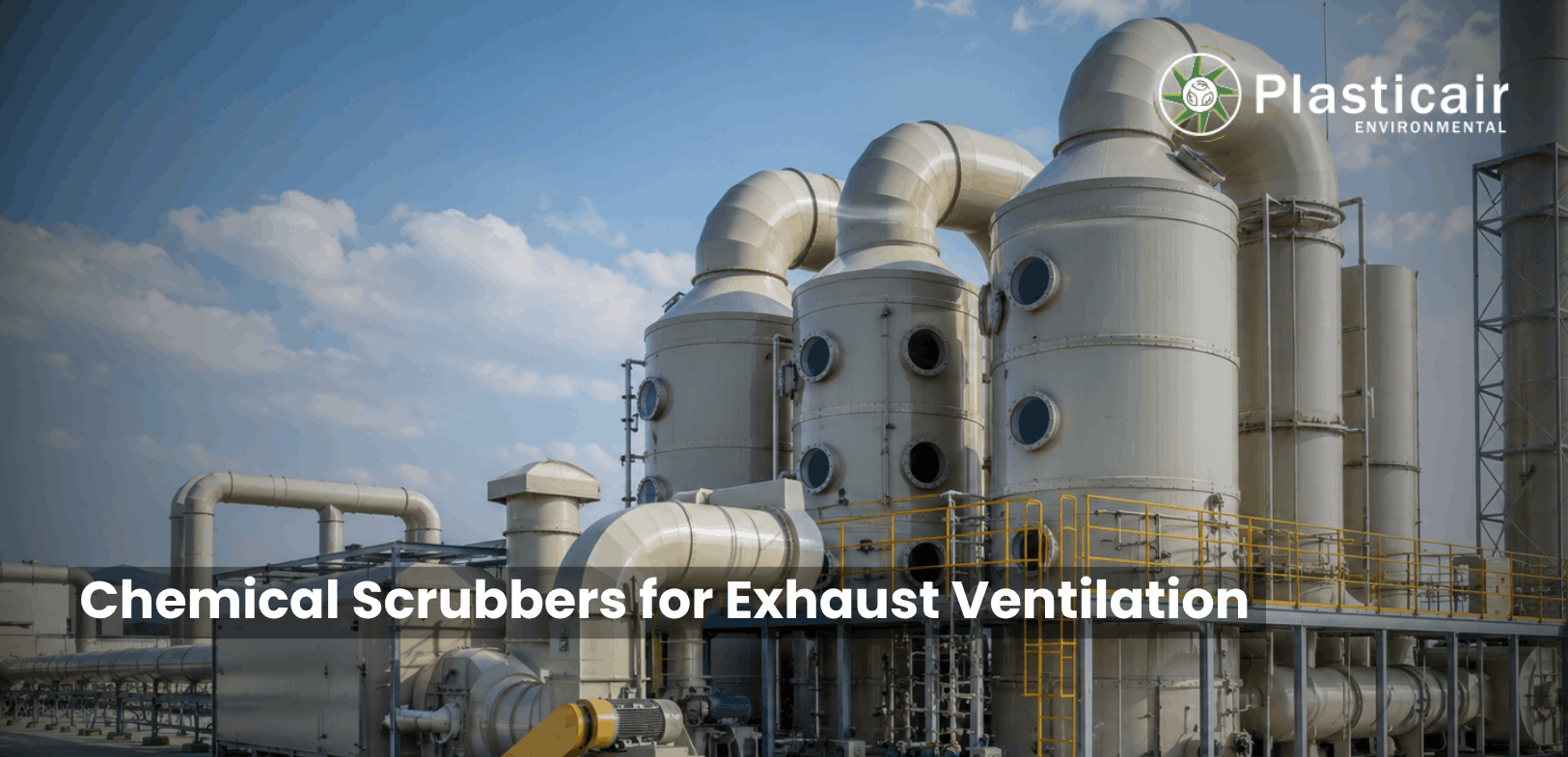
Chemical Scrubbers for Exhaust Ventilation
No two exhaust streams look exactly alike. A wastewater plant deals with hydrogen sulfide and odor. A metal finishing operation deals with acid mist. A chemical manufacturer might face half a dozen different pollutants in the same facility. Chemical scrubbers exist to handle this variety, but choosing the right one starts with understanding what you're actually trying to remove from the air.
This guide breaks down the major categories of chemical scrubbers, how they work, and how to match the right system to your facility's exhaust ventilation systems and specific pollutant profile.
What Are Chemical Scrubbers?
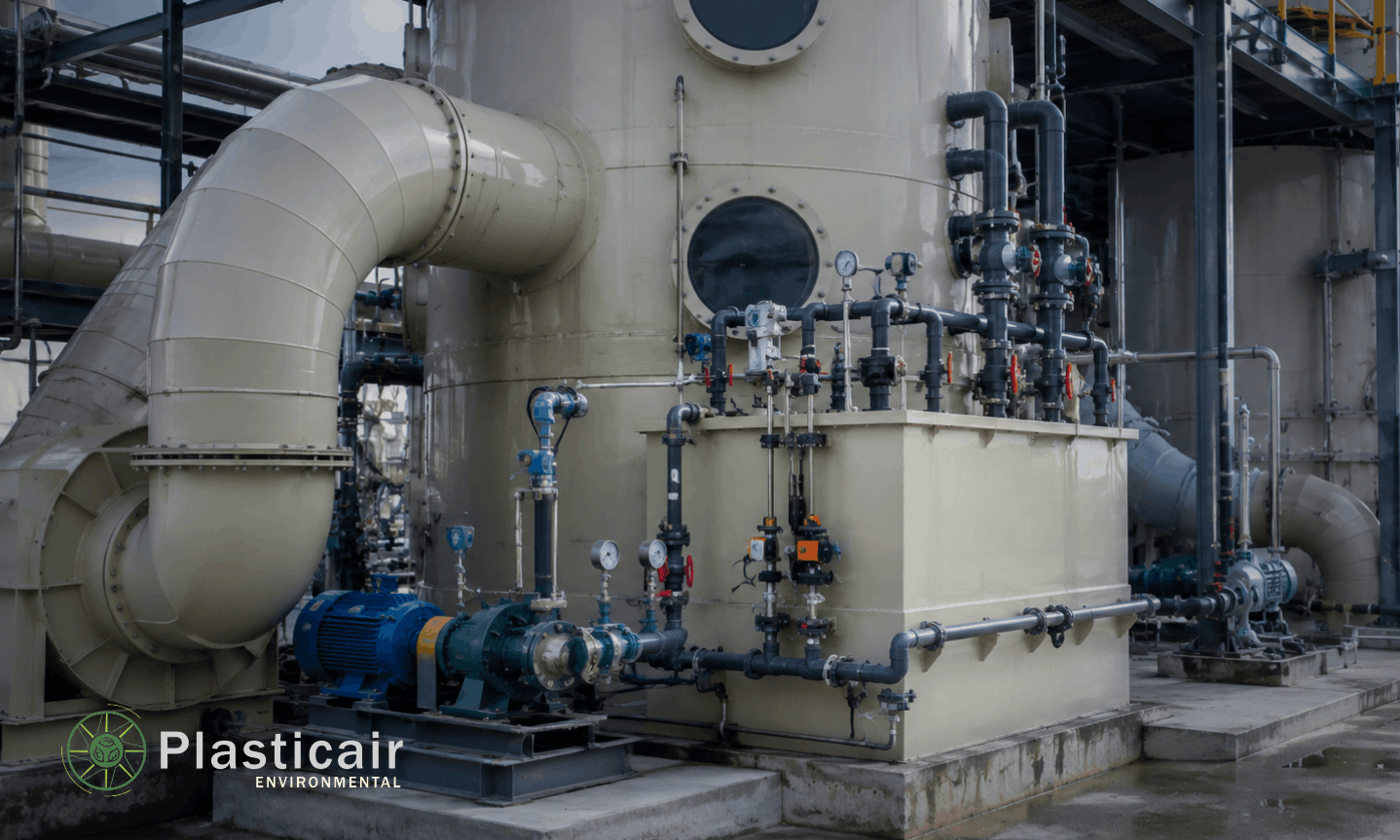
Chemical scrubbers are air pollution control devices that remove chemical contaminants from industrial exhaust before it reaches the atmosphere. The term covers a wide family of chemical fume scrubbers, each engineered around a specific pollutant or class of pollutants, from corrosive acid gases to toxic sour gases to odor-causing compounds. Most designs share a common foundation: a tower built from Fiberglass Reinforced Plastic (FRP), chosen for its resistance to the corrosive byproducts that chemical scrubbing reactions typically produce.
How Chemical Scrubbers Work
Despite covering different pollutants, most chemical scrubbers rely on the same basic principle. Contaminated air is drawn through a tower containing packing media, where it comes into close contact with a circulating liquid — often water, a caustic solution, or an acidic reagent, depending on the target pollutant. Properly designed acid gas scrubbers commonly achieve removal efficiencies above 98%, with packed-tower designs capable of exceeding 99.9% for pollutants like hydrochloric acid. The pollutant transfers from the gas phase into the liquid phase and reacts into a stable, non-hazardous compound, typically neutralizing the discharge stream to a pH in the 6–9 range before release.
Matching the Scrubber to the Chemical
The right system depends entirely on what's in the exhaust stream. A brief breakdown of the major categories:
Acid and Corrosive Gas Streams
Facilities handling sulfuric, hydrochloric, or nitric acid byproducts typically need acid scrubbers built around a caustic scrubbing solution, commonly sodium hydroxide (NaOH) — designed to neutralize acidic gases well below OSHA's exposure limits (for example, OSHA's ceiling limit for hydrochloric acid is 5 ppm) before discharge.
Chlorine and Halogen Gases
Chlorine is one of the more aggressive gases a scrubber will encounter, requiring dedicated design considerations. We cover this in detail in our guide to chlorine scrubbers.
Hydrogen Sulfide and Sour Gas Streams
Common in oil and gas, wastewater treatment, and biogas facilities, hydrogen sulfide requires its own neutralization chemistry. Our H2S scrubbers guide walks through how these systems are engineered.
Odor and VOC-Related Compounds
Odor scrubbers target the volatile organic compounds and sulfur-based odor sources common in food processing, wastewater, and waste management facilities, often prioritizing odor neutralization over strict chemical destruction.
Particulate-Heavy Streams
Where fine particulates are the primary concern rather than gas-phase chemicals, venturi-style designs are often the better fit. Our broader overview of scrubber types covers how these designs compare.
Industries That Rely on Chemical Scrubbers
-
Chemical Manufacturing: Often the most demanding application, with multiple pollutant types requiring industrial exhaust treatment in the same facility.
-
Oil and Gas: Refineries and processing facilities generate sour gas and other byproducts that require continuous treatment.
-
Wastewater Treatment: Organic breakdown produces hydrogen sulfide and odor-causing compounds around the clock.
-
Pharmaceutical Manufacturing: Production processes often involve chemical handling that requires strict exhaust control.
-
Semiconductor and Electronics: Etching and cleaning processes rely on chemical scrubbers to manage tightly regulated exhaust.
-
Food Processing: Odor control is often the primary driver, alongside general air quality management.
Benefits of Chemical Scrubbers
-
Worker Safety: Reduces exposure to gases that are toxic, corrosive, or both, even at low concentrations.
-
Equipment Protection: Prevents corrosive gases from reaching ductwork, fans, and structural components downstream.
-
Regulatory Compliance: Keeps facilities within air quality regulations. OSHA maintains permissible exposure limits for many of the chemicals treated by these systems, and a properly sized scrubber is central to staying within them.
-
Chemical Exhaust Control: Provides consistent, measurable chemical exhaust control rather than relying on dilution alone.
-
Cost Efficiency: Reduces long-term maintenance and compliance costs by preventing corrosion damage before it starts.
Built From FRP for Long-Term Performance
Because most chemical scrubbing reactions produce corrosive byproducts, these systems are almost always paired with FRP fans and fiberglass ductwork rather than standard metal components. FRP construction resists the wear that would otherwise shorten the lifespan of exhaust ventilation systems handling aggressive chemical streams.
Choosing the Right Chemical Scrubber for Your Facility
-
Pollutant Type: The single most important factor. An acid scrubber, an odor scrubber, and an H2S scrubber are not interchangeable.
-
Gas Concentration and Flow Rate: Higher concentrations may require a taller tower, additional packing media, or a higher-capacity system.
-
Packing Media and Reagent Selection: Different pollutants call for different scrubbing chemistries.
-
Facility Footprint: Available space affects whether a vertical or horizontal configuration makes more sense.
-
Multiple Pollutants: Facilities dealing with more than one contaminant type may need multiple scrubber stages rather than a single system.
Maintenance and Inspection Checklist
A chemical scrubber's performance depends on consistent upkeep, not just correct initial sizing. A basic inspection routine to build into a maintenance schedule:
-
Inspect FRP Components: Check the tower, ductwork, and fittings for cracking, discoloration, or resin wear caused by ongoing chemical exposure.
-
Evaluate Packing Media: Look for fouling, channeling, or breakdown that would reduce gas-liquid contact over time.
-
Confirm Reagent and Liquid Delivery: Check pump function, flow rates, and reagent concentration against the levels the system was designed around.
-
Inspect the Mist Eliminator: Clear any buildup that could let liquid carry over into the discharged air.
-
Check Seals, Gaskets, and Fittings: Small leaks tend to start here long before they become visible problems elsewhere in the system.
-
Log Discharge Performance: Test exhaust output regularly against permitted limits rather than assuming performance hasn't drifted.
-
Set a Recurring Schedule: A fixed inspection cadence catches problems while they're still inexpensive to fix.
There is no single chemical scrubber that fits every facility. The right system depends on what's actually in the exhaust stream, and getting that match right is what separates a scrubber that performs for years from one that struggles from day one. Whether the challenge is acid gas, chlorine, hydrogen sulfide, or odor, the right chemical scrubber turns a complex exhaust problem into a manageable part of daily operations.
Plasticair Environmental designs corrosion-resistant scrubbing systems for the full range of industrial exhaust challenges. Visit our Products page to find the right fit for your facility.
Frequently Asked Questions (FAQs)
A chemical scrubber is an air pollution control device that removes chemical contaminants from industrial exhaust using a combination of packing media and a scrubbing liquid, converting pollutants into safer, stable byproducts before clean air is released.
The right scrubber depends on the specific pollutant in your exhaust stream. Acid gases, chlorine, hydrogen sulfide, and odor-causing compounds each require different scrubbing chemistries, so identifying the pollutant is the first step.
Sometimes, but facilities with several distinct contaminant types often need multiple scrubber stages rather than relying on a single system to handle everything at once.
Most chemical scrubbers are built from Fiberglass Reinforced Plastic (FRP) due to its resistance to the corrosive byproducts produced during chemical neutralization.
Most facilities check key components such as packing media, seals, and the liquid delivery system monthly, with a more thorough structural inspection of the tower and ductwork once or twice a year.
Requirements vary by jurisdiction and industry, but many facilities use chemical scrubbers to stay within air quality and exposure limits set by regulatory bodies such as OSHA and the EPA.
Chemical manufacturing, oil and gas, wastewater treatment, pharmaceutical manufacturing, semiconductor production, and food processing are among the heaviest users of chemical scrubbers.