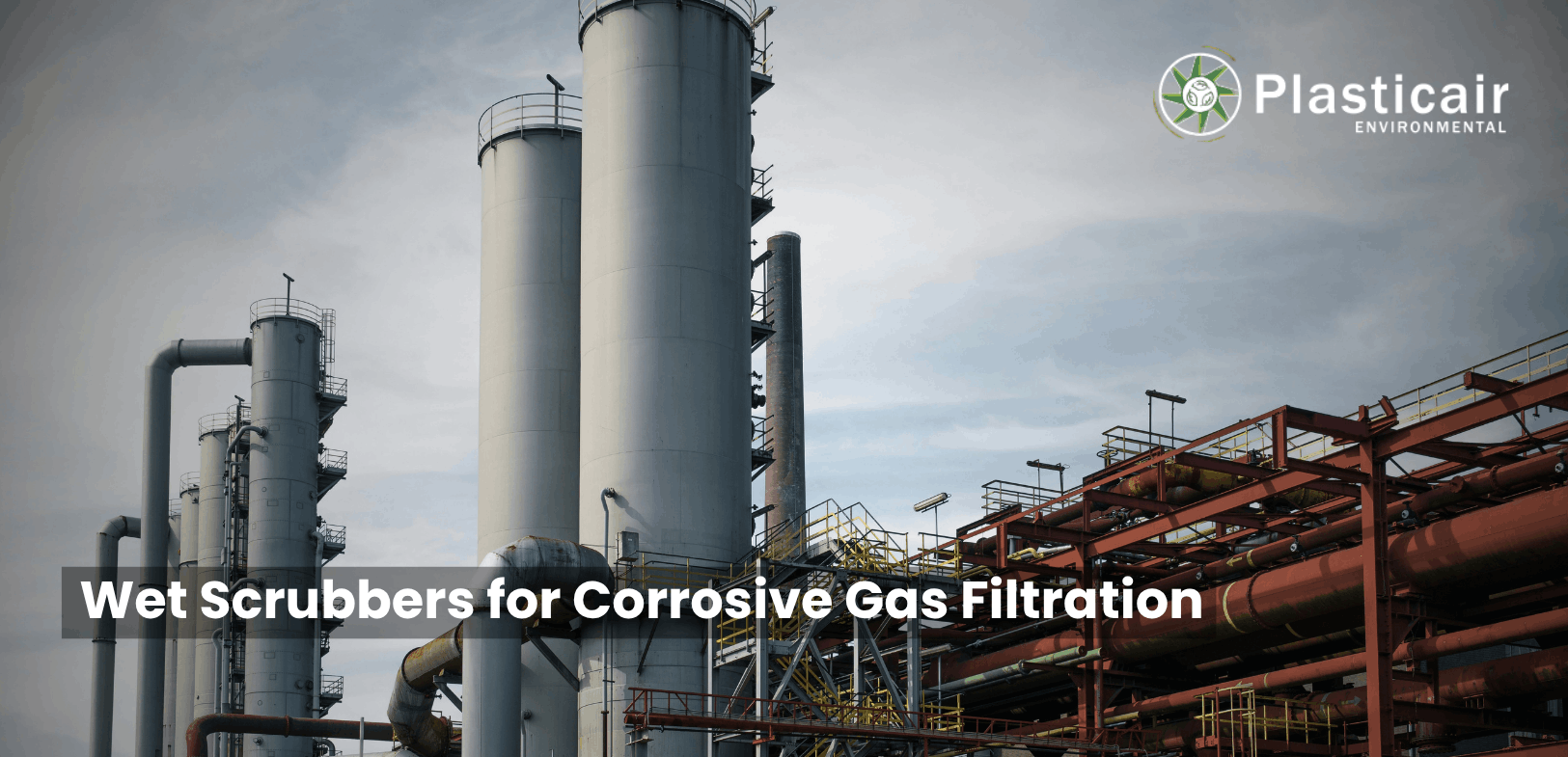
Wet Scrubbers for Corrosive Gas Filtration
When a facility needs to remove corrosive gas from its exhaust stream, the choice usually comes down to two broad approaches: wet or dry. Wet scrubbers have remained the standard for corrosive gas filtration for decades, and for good reason, but that doesn't mean they're automatically the right fit for every application.
This guide compares wet scrubbers against dry systems, breaks down where wet scrubber systems consistently outperform the alternative, and covers what to look for when specifying one for industrial gas filtration.
What Are Wet Scrubbers?
At their core, wet scrubbers rely on a simple mechanism: pulling contaminated exhaust through a liquid, usually water or a chemical solution, to capture and neutralize pollutants before they reach the atmosphere. That liquid-based approach is what sets wet scrubbers apart as a category of air pollution control technology, distinct from dry filtration methods. Chemical scrubbing reactions inside the unit convert corrosive or toxic compounds into stable byproducts, and the corrosive nature of that process is exactly why FRP construction dominates this equipment category; few materials hold up as well against sustained chemical exposure.
Wet Scrubbers vs. Dry Scrubbing Systems
Both approaches remove pollutants from exhaust, but they get there differently, and the differences matter more for some applications than others.
1. Corrosive Gas Handling
-
Wet Scrubbers: Use a liquid solution to absorb and neutralize corrosive gases directly, making them highly effective against acid gases, chlorine, and hydrogen sulfide.
-
Dry Systems: Rely on dry sorbents or filter media, which can struggle with highly soluble corrosive gases and often need more frequent media replacement.
For corrosive gas filtration specifically, wet scrubbers generally have the edge.
2. Byproduct and Waste Management
-
Wet Scrubbers: Produce a liquid discharge stream that requires proper handling or treatment before disposal.
-
Dry Systems: Avoid liquid discharge entirely, producing solid waste instead.
Dry systems simplify byproduct handling, but that convenience often comes at the cost of removal efficiency on demanding gas streams.
3. Maintenance Profile
-
Wet Scrubbers: Require regular monitoring of the scrubbing liquid, packing media, and mist elimination components.
-
Dry Systems: Need periodic media or filter replacement, without liquid-handling equipment to maintain.
The maintenance differs more in kind than in overall burden. Neither approach is maintenance-free.
4. Footprint and Installation
-
Wet Scrubbers: Typically use a tower design, available in vertical or horizontal configurations depending on available space.
-
Dry Systems: Often have a more compact footprint for smaller-volume applications.
Facility layout and flow rate usually decide this one more than either technology's inherent advantages.
5. Best-Fit Applications
-
Wet Scrubbers: Excel with acid gases, chlorine, hydrogen sulfide, ammonia, and other water-soluble corrosive gases.
-
Dry Systems: Tend to be better suited to particulate-heavy or non-soluble pollutant streams.
Types of Wet Scrubber Systems
Wet scrubber systems come in a few common configurations. Packed bed scrubbers use a tower filled with packing media to maximize gas-liquid contact and are among the most widely used designs for corrosive gas filtration. Venturi-style wet scrubbers rely on high-velocity airflow and are better suited to particulate removal than gas absorption. Spray tower designs use a simpler liquid spray without packing media, trading some efficiency for lower pressure drop.
Industries That Rely on Wet Scrubbers
-
Chemical Manufacturing: Often the most demanding setting, with multiple corrosive gas streams requiring air pollution control at once.
-
Oil and Gas: Refineries and processing facilities rely on wet scrubber systems for sour gas and other corrosive byproducts.
-
Wastewater Treatment: Continuous hydrogen sulfide generation makes wet scrubbing a near-constant requirement.
-
Metal Finishing and Electroplating: Acid mist and chromium emissions are common targets for wet scrubber systems.
-
Pharmaceutical and Semiconductor Manufacturing: Process exhaust often requires the removal efficiency wet scrubbers provide.
Benefits of Wet Scrubbers
-
High Removal Efficiency: Particularly effective against soluble corrosive gases that dry systems struggle to capture.
-
Worker and Equipment Protection: Reduces exposure to toxic gases and prevents corrosion damage downstream.
-
Regulatory Compliance: Helps facilities stay within air quality limits. OS HA maintains permissible exposure limits for many of the gases wet scrubbers are designed to treat, and consistent performance is central to staying within them.
-
Versatility: A single wet scrubber platform can often be adapted to acid gases, chlorine, H2S, or odor-causing compounds with the right reagent and packing media.
Built From FRP for Long-Term Performance
Corrosion resistance doesn't stop at the scrubber tower. The fans and ductwork connected to the system face the same aggressive byproducts, so FRP construction typically extends through the entire setup rather than just the scrubber itself. Our FRP fans guide covers this in more depth. For pollutant-specific detail, our guides to chlorine scrubbers, H2S scrubbers, and chemical scrubbers cover how wet scrubbing is applied to specific gas streams.
Choosing the Right Wet Scrubber
-
Pollutant Solubility: Wet scrubbers perform best on gases that dissolve readily into the scrubbing liquid.
-
Gas Concentration and Flow Rate: Higher concentrations may call for a taller tower or additional packing media.
-
Reagent Selection: The scrubbing liquid needs to match the specific chemistry of the target pollutant.
-
Wastewater Handling: Facilities need a plan for treating or discharging the liquid byproduct.
Maintenance and Inspection Checklist
Consistent upkeep is what separates a wet scrubber that performs reliably for a decade from one that underperforms within a year. Build these checks into a recurring routine:
-
Check the Tower and Ductwork: Look for cracking, discoloration, or resin fatigue in the FRP structure after sustained exposure to the scrubbing chemistry.
-
Assess Packing Media Condition: Fouling or channeling in the media reduces the gas-liquid contact the whole system depends on.
-
Verify the Liquid Circulation Loop: Pump performance, flow rate, and reagent strength should all stay within the original design parameters.
-
Clear the Mist Eliminator: Residue buildup here is one of the most common causes of liquid carryover into the exhaust stream.
-
Examine Seals and Connection Points: This is usually where a slow leak begins, long before it becomes an obvious one.
-
Measure Discharge Output Regularly: Performance can drift gradually, so don't rely on assumption between formal tests.
-
Build a Fixed Inspection Schedule: Early detection keeps repair costs low and avoids unplanned shutdowns.
Dry systems have their place, but for corrosive gas filtration specifically, wet scrubbers remain the standard for a reason: they handle soluble corrosive gases more reliably than any dry alternative. The right wet scrubber setup depends on matching pollutant chemistry, flow rate, and facility layout to the right configuration, but the underlying technology has earned its place as the default choice across chemical, oil and gas, and wastewater applications.
For facilities weighing wet scrubber options, our Products page has the full lineup of corrosion-resistant systems Plasticair Environmental builds for demanding exhaust conditions.
Frequently Asked Questions (FAQs)
At its simplest, a wet scrubber pulls contaminated exhaust through a liquid solution that captures and neutralizes pollutants, part of the broader category of air pollution control equipment, before releasing treated air back into the atmosphere.
It depends on the pollutant. Wet scrubbers generally outperform dry systems on soluble corrosive gases like acid gases, chlorine, and hydrogen sulfide, while dry systems can be a better fit for particulate-heavy, non-soluble streams.
The scrubbing liquid absorbs and neutralizes pollutants as it circulates through the system. It eventually becomes a wastewater stream that needs to be treated or disposed of according to facility and regulatory requirements.
FRP is the dominant choice industry-wide. Its ability to withstand years of exposure to corrosive scrubbing byproducts is hard to match with standard metal alternatives.
Packing media, seals, and liquid circulation are worth a monthly look. The tower and ductwork can go on a longer cycle, once or twice yearly is typical, unless the facility runs an especially aggressive gas stream.
With the right reagent and packing media, sometimes. But facilities juggling several distinct contaminants usually get better results running separate scrubber stages instead of asking one system to do it all.
Chemical manufacturing, oil and gas, wastewater treatment, metal finishing, and pharmaceutical and semiconductor manufacturing are among the heaviest users of wet scrubber systems.